

Written by: Cellular Institute Editorial Team
Medical reviewer: Dr. Matilde Rodríguez – CP 12651081
Laboratory reviewer: Biotecnóloga Diana Navarrete – CP 15029468
Quick Answer
Stem cell therapy for fibromyalgia is an emerging area within regenerative medicine. Early research and clinical observations suggest that mesenchymal stem cells may support immune modulation, inflammation regulation, and nervous system signaling in some patients. These mechanisms are relevant to fibromyalgia, a condition that researchers increasingly connect to central sensitization, neuroinflammation, and immune dysregulation. However, stem cell therapy does not cure fibromyalgia, results vary significantly by patient, and physician evaluation is required before any protocol can be recommended.
Why Fibromyalgia Patients Are Exploring Regenerative Medicine
Fibromyalgia is one of the most frustrating conditions to manage. Patients describe years of doctor visits, medication trials, physical therapy, and lifestyle changes that bring partial relief at best. For many, the standard toolkit simply does not go far enough.
That frustration is driving more patients toward regenerative medicine in Cancún and other advanced options. The logic is straightforward. If the underlying problem involves how the nervous system processes pain signals, how the immune system behaves, and how inflammation persists in the body, then therapies designed to influence those systems at a cellular level deserve serious consideration.
Stem cell therapy does not replace conventional care. But for patients who have exhausted standard options, it may offer a different starting point.
What We Know About Fibromyalgia and the Immune System
For decades, fibromyalgia was poorly understood. Many clinicians treated it primarily as a pain management problem. More recent research points to a more complex picture involving central sensitization, neuroinflammation, altered immune activity, and mitochondrial dysfunction.
This matters because mesenchymal stem cells, the type most commonly used in regenerative protocols, naturally interact with the immune system. They release signaling molecules that may help modulate inflammatory responses and support tissue communication. Researchers studying these properties have proposed that this immunomodulatory activity could be relevant in conditions where immune dysregulation plays a role.
Fibromyalgia appears to be one such condition. Studies have identified elevated inflammatory markers and altered immune profiles in a meaningful subset of fibromyalgia patients. This overlap between fibromyalgia biology and stem cell mechanisms is part of what makes this an active area of clinical interest.
That said, the evidence base is still developing. Patients should approach this with realistic expectations and responsible medical guidance. Stem cell therapy may support certain aspects of fibromyalgia-related dysfunction in appropriate candidates, but it does not eliminate the condition for everyone.
How a Physician-Guided Protocol May Address Multiple Mechanisms
One of the most important ideas in modern regenerative medicine is that a single therapy rarely tells the whole story. Fibromyalgia affects multiple systems simultaneously: pain processing, sleep, energy, mood, immune balance, and inflammation. A well-designed protocol addresses as many of those layers as possible.
At Cellular Institute, the medical team evaluates each patient individually before designing any protocol. That evaluation considers inflammatory burden, immune status, mitochondrial function, prior treatment history, and overall health goals. The result is a personalized plan that may combine stem cell therapy with complementary modalities designed to support the body more completely.
For fibromyalgia patients, additional tools may include EBOO therapy in Cancún, an advanced blood filtration approach that may help reduce systemic inflammatory load. Patients with significant oxidative stress and fatigue may benefit from this as part of their broader protocol. The team may also consider peptide therapy to support recovery, energy regulation, and cellular optimization alongside the primary regenerative intervention.
Recovery technologies such as hyperbaric oxygen therapy, red light therapy, and PEMF may further support the nervous system and cellular repair process. The goal is not to provide one injection and send patients home. The goal is to support the body across multiple systems in a coordinated, medically supervised way.
What Patients Should Know About Stem Cell Quality
Not all stem cell therapies carry the same clinical value. The quality of the biologic product matters enormously, and many patients do not realize how much variation exists from clinic to clinic.
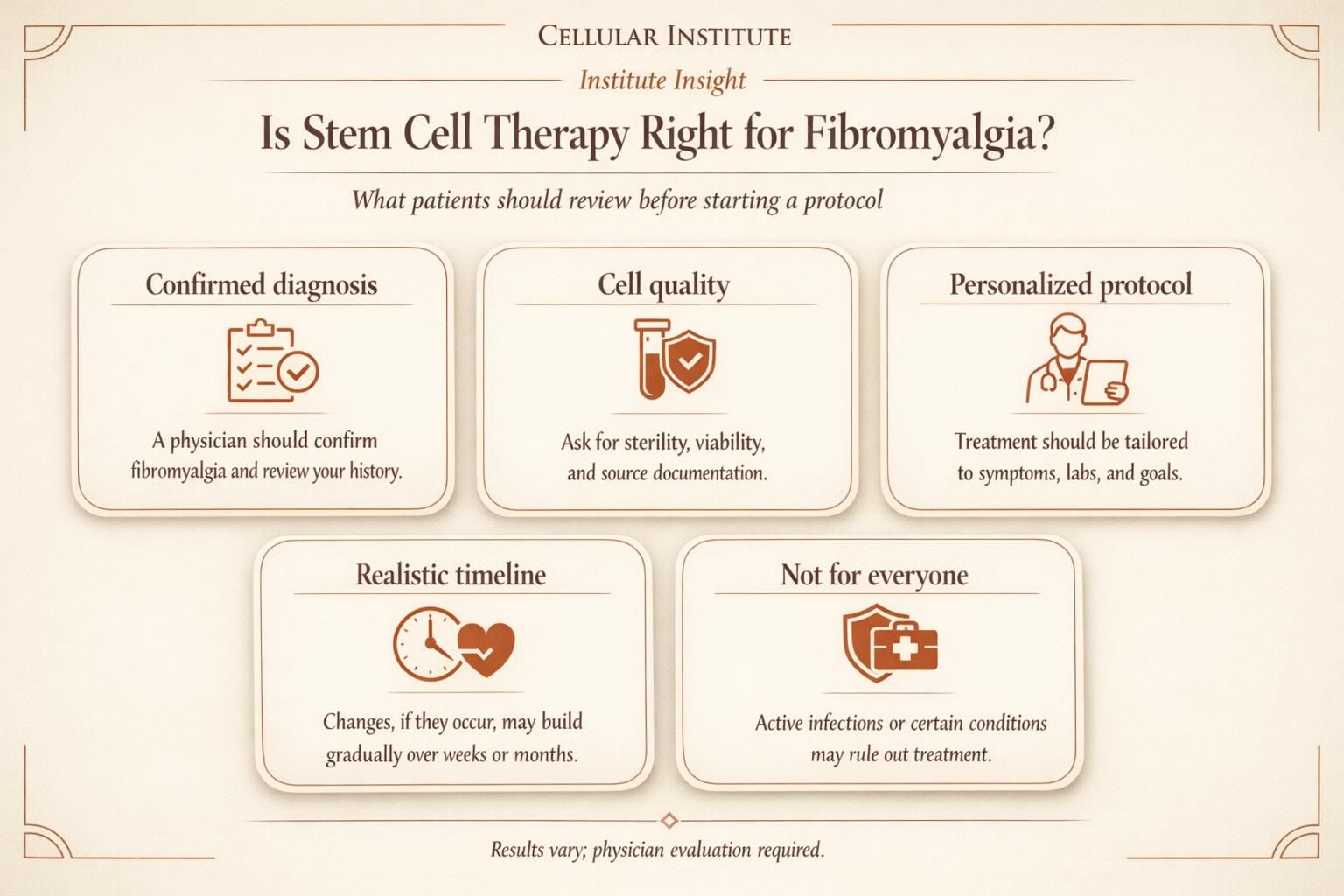
Key factors that influence quality include cell viability, sterility, sourcing transparency, processing standards, and whether the clinic provides documentation such as a certificate of analysis. Patients should ask where the cells come from, how they are processed, and what testing confirms their safety and potency before administration.
Cellular Institute works with certified stem cells that meet documented quality standards. The clinic’s affiliated lab ecosystem through Cellgenic supports traceability, viability testing, sterility verification, and xeno-free processing. This level of documentation is not universal in the industry. Patients who understand what to ask for are better equipped to compare options and make informed decisions.
For patients considering treatment abroad, understanding stem cell therapy safety in Mexico is an important part of the research process. Regulatory frameworks, clinic licensing, and product documentation vary significantly between providers.
Who May Be a Candidate for This Approach
Patients who tend to be considered for stem cell therapy in a fibromyalgia context generally share several characteristics. They have received a confirmed fibromyalgia diagnosis and have worked with conventional medicine without achieving adequate relief. They show evidence of inflammatory or immune involvement in their presentation. They do not have active conditions that would contraindicate regenerative therapy. And they approach the process with realistic expectations and a commitment to the full protocol.
Age, overall health status, medication history, and coexisting conditions all influence candidacy. This is why a thorough physician evaluation is required before any treatment recommendation. Fibromyalgia manifests differently in every patient, and the protocol must reflect those individual differences.
Who May Not Be a Good Candidate
Stem cell therapy is not appropriate for every fibromyalgia patient. Patients with certain active infections, malignancies, severe autoimmune flares, or other significant medical conditions may not qualify. Patients who expect a single session to eliminate all symptoms are also likely to be disappointed. Regenerative medicine works best when patients understand that the process unfolds over time and that results vary.
The medical team at Cellular Institute evaluates each candidate carefully. If a patient is not a good fit for stem cell therapy, the team will say so and may suggest alternative supportive options instead.
How Cellular Institute Approaches Fibromyalgia Protocols
Cellular Institute does not sell a standard fibromyalgia package. The team begins with a thorough evaluation of each patient’s medical history, labs, inflammatory markers, and treatment goals. From there, the medical team designs a protocol that reflects the individual’s specific presentation.
Dr. Roni Moya, Immunologist, plays an important role in evaluating patients with immune and inflammatory complexity. His involvement ensures that the protocol accounts for the immune system factors that often contribute to fibromyalgia’s most persistent symptoms. Medical oversight from Dr. Rafael Moguel, Medical Director, adds another layer of clinical rigor to the evaluation and treatment process.
International patients traveling to Cancún receive full coordination support, including pre-treatment consultation, bilingual patient coordination, airport logistics, and structured follow-up after returning home. The experience is designed to feel medically guided and personally supported from start to finish.
Questions to Ask Before Choosing a Clinic
Patients evaluating stem cell therapy for fibromyalgia should ask the following questions before committing to any provider.
- What type of stem cells do you use, and where do they come from?
- Can you provide a certificate of analysis confirming viability and sterility?
- Does a physician evaluate my case before designing the protocol?
- What complementary therapies are included or recommended alongside stem cell therapy?
- What does follow-up support look like after treatment?
- What is your regulatory standing and licensing structure?
- What realistic outcomes should I expect, and over what timeline?
Patients who ask these questions will quickly distinguish between clinics that prioritize transparency and those that prioritize volume. For additional guidance on evaluating providers, the article on how to choose a stem cell clinic in Mexico covers the most important criteria in detail.

Frequently Asked Questions
Can stem cell therapy cure fibromyalgia?
No. Stem cell therapy does not cure fibromyalgia. In appropriately selected candidates, it may support immune modulation, inflammation regulation, and nervous system signaling in ways that could reduce certain symptoms over time. Results vary significantly by patient, and responsible expectations are essential before pursuing any regenerative protocol.
How long does it take to notice results after stem cell therapy for fibromyalgia?
Timelines vary. Some patients report gradual improvements in energy, sleep quality, and pain levels within weeks of treatment. Others notice changes over a period of several months as the body responds to the regenerative process. For more on what to expect, the article on how long stem cell therapy results may last provides useful context.
Is traveling to Cancún for fibromyalgia treatment realistic?
Many international patients from the United States and Canada travel to Cancún specifically for regenerative medicine protocols. Cellular Institute supports the full patient journey, including pre-travel consultation, bilingual coordination, airport logistics, clinic care, and follow-up after departure. Cancún is a well-established destination for medical tourism in Mexico, and the infrastructure for international patients is strong.
How much does stem cell therapy for fibromyalgia cost?
Costs vary based on the protocol design, number of sessions, complementary therapies included, and the quality of the biologic product used. Patients researching pricing can review the detailed breakdown in the article on stem cell therapy cost in Mexico for a realistic overview of what to expect.
Final Thoughts
Fibromyalgia is a complex condition, and patients who have not found adequate relief through conventional medicine deserve access to thoughtful, evidence-informed alternatives. Stem cell therapy may offer meaningful support for some patients, particularly those with inflammatory or immune components to their condition. But the therapy is only one part of a larger strategy.
The quality of the biologic product, the depth of the physician evaluation, the design of the supporting protocol, and the structure of the patient journey all determine whether the experience delivers genuine value. Cellular Institute approaches each fibromyalgia patient as an individual with a unique clinical picture, not as a diagnosis to fill a standard package.
If you are considering regenerative medicine as part of your fibromyalgia management strategy, the most important first step is a genuine medical evaluation. Schedule a discovery call with the Cellular Institute team to discuss your history, your goals, and whether this approach may be appropriate for your case.
Medical Disclaimer
This article is for educational purposes only and does not replace medical advice, diagnosis, or treatment. Regenerative therapies are not appropriate for every patient, and outcomes vary. A licensed physician must evaluate your medical history, goals, and candidacy before any treatment can be recommended.