

Written by: Cellular Institute Editorial Team
Medical reviewer: Dr. Matilde Rodríguez – CP 12651081
Laboratory reviewer: Biotecnóloga Diana Navarrete – CP 15029468
Quick Answer
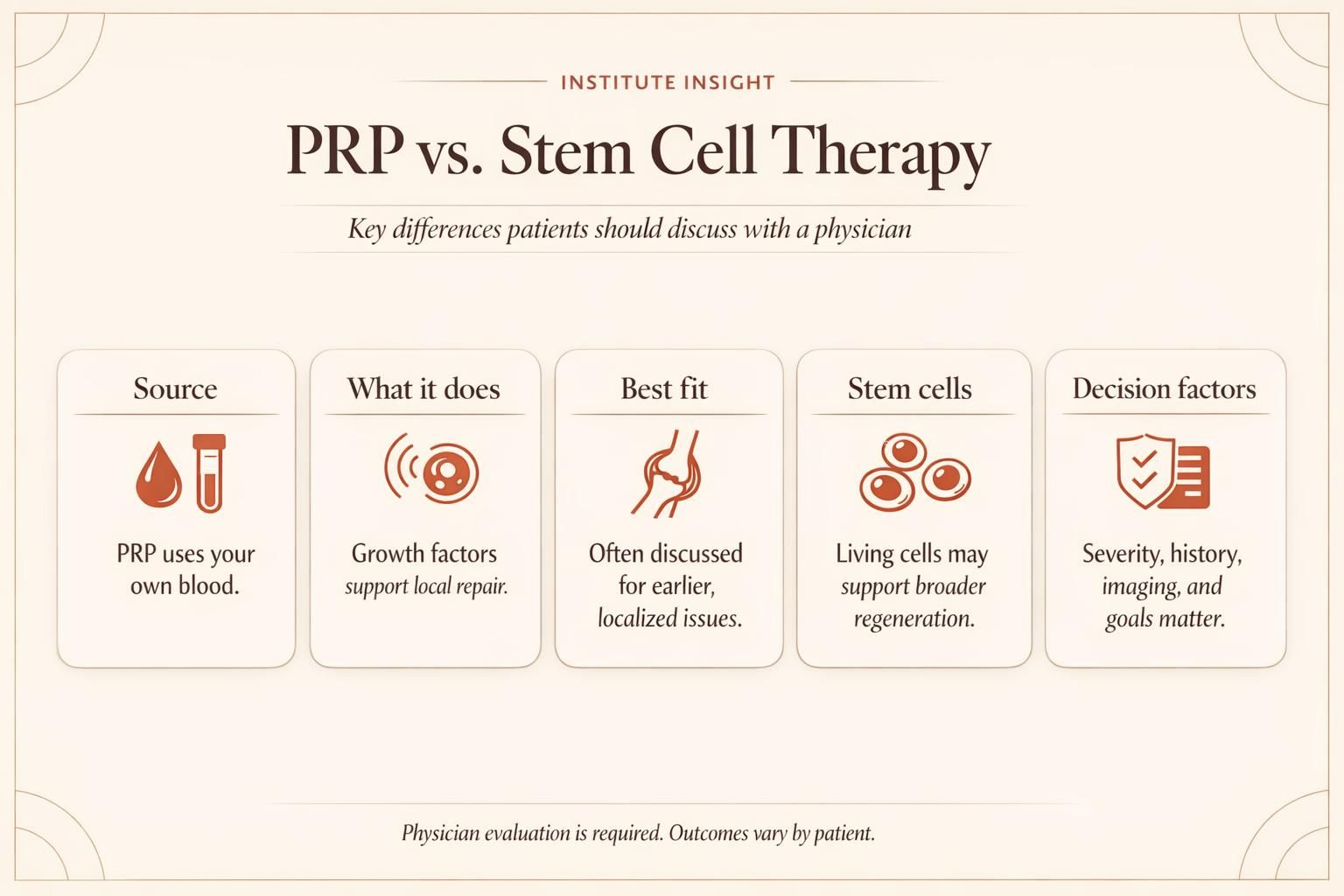
PRP and stem cell therapy are both regenerative tools, but they work through different mechanisms and may be appropriate for different conditions. PRP uses concentrated growth factors from your own blood to support tissue repair. Stem cell therapy introduces living cells that may support a broader regenerative response. Neither option is appropriate for every patient. A physician must evaluate your condition, medical history, and goals before recommending either approach.
What Patients Should Know Before Comparing These Two Options
Many patients arrive at this question after months of managing joint pain, a stubborn tendon injury, or early cartilage degeneration. They have heard about both options and want to know which one is better. The honest answer is that it depends on the clinical picture.
PRP, or platelet-rich plasma, draws from your own blood. A technician processes a small blood sample to concentrate the platelets, which carry growth factors that may support healing at the injury site. The procedure is minimally invasive and relatively straightforward.
Stem cell therapy involves introducing mesenchymal stem cells, typically sourced from umbilical cord tissue or other allogeneic sources, into the body. These cells carry signaling properties that may support tissue repair, inflammation modulation, and local regenerative activity. The scope of action tends to be broader than PRP alone.
Neither option replaces conventional orthopedic care. Both require physician evaluation to determine whether a patient is an appropriate candidate.
Which Conditions May Respond Better to PRP
PRP may be considered for patients with earlier-stage or more localized conditions. Physicians sometimes recommend it for tendon injuries, mild to moderate joint inflammation, ligament support, and certain soft tissue recovery contexts.
Common situations where PRP may be discussed include:
- Mild to moderate knee or shoulder discomfort
- Tendinopathy, such as Achilles or patellar tendon irritation
- Ligament strains without complete tears
- Mild degenerative joint changes in earlier stages
- Post-exercise or sports-related soft tissue stress
PRP is often seen as a lower-intervention starting point. Some patients try PRP before considering stem cell therapy. Others use both as part of a layered protocol.
Which Conditions May Be Better Suited to Stem Cell Therapy
Stem cell therapy may be considered for patients with more advanced degeneration, broader inflammatory burden, or conditions that have not responded sufficiently to other approaches. It may also appeal to patients who want to address multiple areas or support systemic regenerative goals.
Situations where physicians may discuss stem cell therapy include:
- Moderate to advanced osteoarthritis in the knee, hip, or shoulder
- Cartilage loss or joint space narrowing
- Chronic tendon or disc-related issues that have not improved
- Patients who want broader support beyond a single injection site
- Individuals combining regenerative therapy with longevity or wellness optimization goals
Stem cell therapy is not a guaranteed alternative to surgery. It may support the body’s repair mechanisms, but outcomes depend heavily on the patient’s biology, condition severity, and overall health status.
To learn more about the range of available options, our article on types of stem cell treatments in Mexico offers a helpful starting point for patients still exploring what may fit their situation.
Cost and Invasiveness: Key Differences to Understand
PRP is generally less expensive than stem cell therapy. It requires only a blood draw and a short centrifuge process. The procedure itself is minimally invasive and typically completed in one visit. Recovery time is minimal for most patients.
Stem cell therapy tends to involve a higher investment. The cost reflects the sourcing, processing, quality standards, and clinical oversight required. At a clinic like Cellular Institute, the cost also reflects in-house lab support through Cellgenic, physician evaluation, personalized protocol design, and follow-up coordination.
If you are comparing pricing across clinics, our detailed breakdown of stem cell therapy cost in Mexico explains what should be included in a responsible quote and what low pricing may actually indicate about quality.
What Affects Quality and Safety in Both Options
Quality matters in both PRP and stem cell therapy, but the variables differ.
For PRP, key factors include the concentration protocol, centrifuge quality, platelet count, and whether the process follows clinical standards. Not every PRP preparation is equal.
For stem cell therapy, the stakes around quality are higher. Patients should ask where the cells originate, how they are processed, what documentation exists for viability and sterility, and whether the clinic operates under regulatory oversight.
At Cellular Institute, stem cell products are supported by Cellgenic, our affiliated biologics ecosystem. This means greater traceability, xeno-free processing standards, viability and sterility documentation, and a clearer bridge between lab science and clinical care. Patients can review our certified stem cells page to understand the quality standards behind what we use.
For patients evaluating clinics, our guidance on how to choose a stem cell clinic in Mexico walks through the right questions to ask before committing to any provider.
Should You Do PRP Before Stem Cell Therapy
Some patients ask whether PRP should come first. In certain clinical situations, a physician may recommend PRP as an initial step, particularly for younger patients, those with milder conditions, or those who want to begin with a less intensive intervention.
In other cases, the physician may recommend moving directly to stem cell therapy based on the patient’s condition, imaging, history, and goals. Some protocols combine both approaches, using PRP to support local healing while stem cells address a broader regenerative objective.
There is no universal sequence. The right order depends on what the physician determines after a thorough evaluation. At Cellular Institute, Dr. Wajid Burad, Orthopedist, specializes in evaluating musculoskeletal conditions and helping patients understand which regenerative options may be appropriate for their specific situation.
How Cellular Institute Approaches This Decision
Cellular Institute does not offer a one-size-fits-all recommendation. Every patient begins with a medical evaluation. The physician reviews imaging, labs, health history, and goals before designing a protocol.
Some patients receive PRP. Some receive stem cell therapy. Some receive a combination that may also include complementary tools such as recovery technologies, peptide therapy, or advanced blood support therapies. The protocol reflects the patient, not a menu.
This integrated approach is part of what defines regenerative medicine in Cancún at our clinic. We are not selling a single injection. We are guiding each patient through a personalized, physician-led regenerative experience.
Who May Be a Candidate for Either Option
You may be a candidate for PRP or stem cell therapy if you have a musculoskeletal condition that has not responded fully to conventional care, you are not yet at the stage where surgery is unavoidable, and you are in generally stable health. Physician evaluation will clarify whether you qualify and which approach fits your case.
Who May Not Be a Candidate
Patients with active infections, certain blood disorders, some cancers, or other contraindicated conditions may not be appropriate candidates. Physician evaluation is required before any regenerative therapy. Results vary by patient, and no outcome can be guaranteed.

Frequently Asked Questions
Is PRP or stem cell therapy better for knee pain?
It depends on the severity and cause of the knee pain. Mild to moderate cases may respond well to PRP. More advanced degeneration or cartilage loss may prompt a physician to discuss stem cell therapy instead. A proper evaluation with imaging and clinical assessment is the only way to determine the right fit for your specific condition.
Can PRP and stem cell therapy be used together?
Yes. In some protocols, physicians combine PRP and stem cell therapy to support different aspects of the healing process. PRP may enhance the local environment, while stem cells address a broader regenerative objective. Whether this combination makes sense depends entirely on the individual patient and the physician’s clinical reasoning.
How long do results from stem cell therapy last compared to PRP?
Results vary significantly between patients and depend on the condition being addressed, the quality of the biologic product, and the overall protocol. For a deeper look at what to realistically expect, our article on how long stem cell therapy results may last provides a more detailed breakdown.
Is it safe to receive these treatments in Mexico?
Safety depends on the clinic, not the country. Patients should ask about regulatory structure, physician credentials, product sourcing, and quality documentation. Our article on stem cell therapy safety in Mexico addresses common concerns and explains what responsible clinics should be able to demonstrate.
Final Thoughts
Choosing between PRP and stem cell therapy is not a decision patients should make based on price or a quick online search alone. Both options have a role in regenerative medicine. Both require physician evaluation. And both produce results that vary based on individual biology, condition severity, and protocol quality.
At Cellular Institute, we take the time to understand each patient’s situation before recommending anything. Our team, led by experienced physicians and supported by in-house lab expertise, designs protocols around the patient, not around a standard package.
If you are ready to explore whether PRP, stem cell therapy, or a combined regenerative protocol may be appropriate for your condition, we invite you to schedule a discovery call with our patient coordination team. We will help you understand your options and see if you are a candidate for care at Cellular Institute in Cancún.
Medical Disclaimer
This article is for educational purposes only and does not replace medical advice, diagnosis, or treatment. Regenerative therapies are not appropriate for every patient, and outcomes vary. A licensed physician must evaluate your medical history, goals, and candidacy before any treatment can be recommended.