
Written by: Cellular Institute Editorial Team
Medical reviewer: Dr. Matilde Rodríguez – CP 12651081
Laboratory reviewer: Biotecnóloga Diana Navarrete – CP 15029468
Quick Answer
Stem cell therapy for ALS is not a cure. No regenerative therapy currently approved or available can stop or reverse ALS progression. However, evidence-informed protocols using mesenchymal stem cells and related biologics are being explored in clinical and research settings for their potential to support neuroprotection, reduce neuroinflammation, and help preserve quality of life during earlier disease stages. Physician evaluation is required to determine whether a patient may be an appropriate candidate for a regenerative medicine protocol.
What ALS Patients and Families Should Know First
ALS, or amyotrophic lateral sclerosis, is a progressive neurodegenerative disease. It affects the motor neurons that control voluntary movement. Over time, patients lose the ability to speak, swallow, move, and breathe independently.
Conventional medicine offers limited options for slowing progression. Riluzole and edaravone remain the most commonly used pharmacological agents. Neither stops the disease. Families facing an ALS diagnosis often search for anything that might preserve function longer or improve quality of life during the time that matters most.
This search brings many patients and families to regenerative medicine. It is important to approach this area with both openness and honest expectations. Stem cell therapy for ALS is being studied. Some patients report subjective improvements in quality of life, energy, or stabilization over short observation periods. However, randomized controlled trial evidence remains limited, and results vary significantly between patients.
At Cellular Institute, we believe patients deserve complete honesty. We do not offer cures. We offer physician-guided regenerative protocols designed to support the body’s biological environment, reduce inflammatory burden, and optimize the conditions under which the nervous system functions.
How Regenerative Medicine May Fit Into an ALS Protocol
Researchers studying regenerative approaches to ALS have focused primarily on mesenchymal stem cells, or MSCs. These cells carry anti-inflammatory and neuroprotective properties. They do not replace lost motor neurons. Instead, they may create a more supportive biological environment for surviving neurons.
The theoretical mechanisms under investigation include:
- Reduction of neuroinflammation driven by activated microglia and astrocytes
- Release of neurotrophic factors that may support motor neuron survival
- Modulation of the immune environment around the nervous system
- Potential reduction of oxidative stress in affected neural tissue
Exosome therapy has also entered the research conversation. Exosomes are extracellular vesicles that carry signaling molecules between cells. Some researchers believe they may deliver neuroprotective signals more efficiently than whole cells in certain neurological contexts. These are still early-stage findings, but they represent an important direction in advanced regenerative science.
Complementary modalities such as hyperbaric oxygen therapy, EBOO-based blood therapies, and peptide therapy may also play a supportive role in managing systemic inflammation and oxidative stress. These are not ALS treatments. They are tools that may help optimize the patient’s internal environment as part of a broader physician-designed protocol.
Learn more about regenerative medicine in Cancún and what a personalized protocol may include.
What Makes Biologic Quality Critical in a Neurological Context
When a patient with ALS considers stem cell therapy, the quality of the biologic product matters enormously. Neurological applications require cells with high viability, documented sterility, traceable sourcing, and consistent processing standards.
Many clinics around the world outsource their biologic products with limited visibility into sourcing, passage number, viability rates, or safety testing. This lack of transparency is a serious concern, particularly for neurological conditions where the stakes are high and the patient’s resilience may already be compromised.
At Cellular Institute, our affiliated biologics ecosystem through Cellgenic supports in-house quality control, xeno-free processing standards, and full traceability from sourcing through clinical delivery. Our certified stem cells meet documented quality standards including viability, sterility, and certificate of analysis documentation.
This level of transparency is not universal. It is one of the reasons patients and families researching ALS-related regenerative protocols choose to evaluate Cellular Institute carefully before making any decision.
Who May Be a Candidate for Regenerative Protocols in the ALS Context
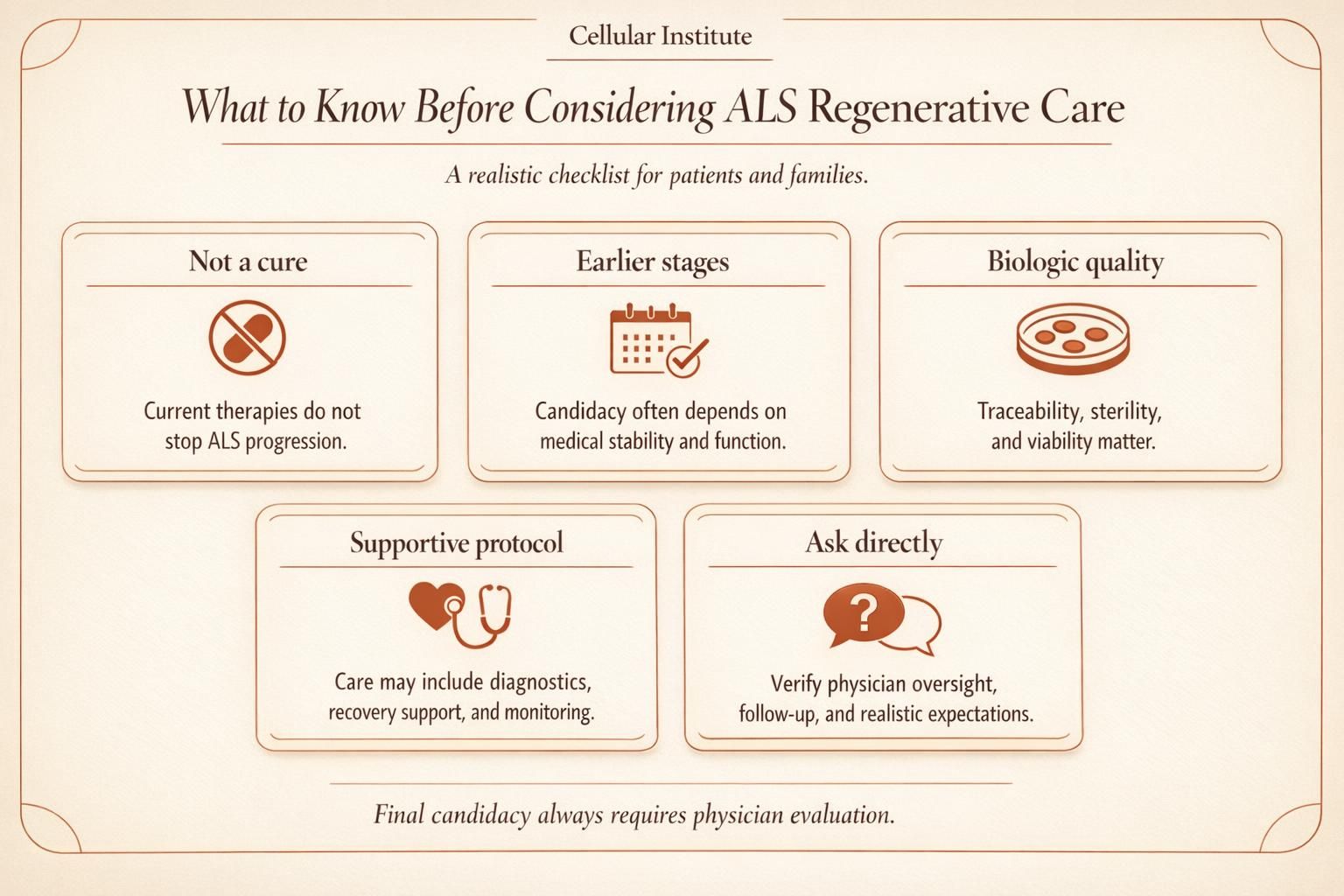
Physician evaluation is always required. That said, regenerative medicine consultations for ALS-related purposes tend to focus on patients who are:
- In earlier to mid stages of disease progression
- Medically stable enough to travel and tolerate a clinical protocol
- Not currently in acute respiratory distress or critical care
- Seeking supportive optimization alongside, not instead of, conventional neurological care
- Approaching treatment with realistic expectations and a quality-of-life focus
Patients with advanced ALS, significant respiratory compromise, or complex comorbidities may not be appropriate candidates. Our medical team evaluates each patient individually and will communicate honestly about what may or may not be appropriate for a given case.
Who Is Likely Not a Candidate
Not every ALS patient will qualify for a regenerative medicine protocol. Patients unlikely to be candidates include those with:
- Severe respiratory insufficiency requiring continuous ventilatory support
- Active systemic infection or uncontrolled inflammation
- Advanced organ dysfunction that increases procedural risk
- Conditions that contraindicate biologic administration under our safety protocols
Responsible candidate evaluation protects patients. We take that responsibility seriously.
How Cellular Institute Approaches ALS-Related Regenerative Protocols
Cellular Institute does not offer a standardized ALS package. Every patient who contacts us goes through a thorough medical evaluation before any protocol discussion begins.
Our team, led by Dr. Rafael Moguel, Medical Director, reviews medical history, current neurological status, functional capacity, inflammatory markers, and patient goals. We also work alongside our immunology team, including Dr. Roni Moya, Immunologist, to evaluate the immune and inflammatory environment before designing any protocol.
A complete protocol at Cellular Institute may combine stem cell therapy with supportive modalities such as exosome therapy, EBOO blood therapies for systemic inflammation support, recovery technologies, and peptide therapy where clinically appropriate. Every element serves a specific purpose within the broader strategy.
Our laboratory team, including Biotechnologist Diana Navarrete, ensures that every biologic product meets our documented quality standards before it reaches any patient. This is not standard practice across the industry. It is a non-negotiable standard at Cellular Institute.
If you are evaluating options, our guide on how to choose a stem cell clinic in Mexico may help you ask the right questions of any provider you consider.
Questions to Ask Before Choosing a Clinic
ALS patients and families face enormous pressure to find answers quickly. Clinics that exploit that urgency do serious harm. Before committing to any provider, ask these questions directly:
- Where do the stem cells or exosomes come from, and what documentation exists for their sourcing?
- What viability, sterility, and quality testing does the clinic conduct before administering biologics?
- Who is the supervising physician, and what is their training in regenerative medicine?
- Does the clinic promise a cure or guarantee specific outcomes for ALS patients?
- What does the protocol include beyond the injection itself?
- What follow-up and monitoring does the clinic provide after treatment?
Any clinic that promises to stop or reverse ALS should raise serious concern. Evidence-informed care means being honest about what regenerative medicine may support and what it cannot do.

Frequently Asked Questions
Can stem cell therapy stop ALS progression?
No regenerative therapy currently available can stop or reverse ALS progression. Stem cell protocols are being explored for their potential to support neuroprotection and reduce neuroinflammation, but they are not a cure and should not be presented as one. Patients should approach any clinic claiming otherwise with caution.
Is stem cell therapy for ALS safe?
Safety depends heavily on the quality of the biologic product, the clinical environment, physician oversight, and the individual patient’s medical status. At Cellular Institute, every protocol begins with a thorough medical evaluation and uses certified biologics with documented viability, sterility, and traceability. To learn more about safety standards, read our article on stem cell therapy safety in Mexico.
What might an ALS patient realistically expect from regenerative therapy?
Realistic expectations include potential support for quality of life, immune modulation, and reduction of systemic inflammatory burden. Some patients report subjective improvements in energy or stability over short periods. Results vary significantly between patients, and no outcome can be guaranteed. A physician must evaluate each case individually before any expectations can be discussed.
How much does stem cell therapy cost for ALS patients in Mexico?
Protocol costs vary based on the complexity of the plan, the biologics included, and the supportive modalities recommended. For a general overview of pricing factors, visit our guide on stem cell therapy cost in Mexico. We recommend speaking with our team directly to understand what a medically appropriate protocol would involve for your specific situation.
Final Thoughts
ALS is one of the most challenging diagnoses a person and a family can face. The search for any option that might help is entirely understandable. Regenerative medicine is not a miracle and not a cure. However, it represents a serious and evolving area of science that may offer meaningful supportive value for appropriately selected patients.
At Cellular Institute, we take the responsibility of working with ALS patients seriously. We do not overpromise. We evaluate carefully. We design protocols around the individual, not around a generic treatment menu. And we support our patients through every step of their journey in Cancún, from arrival through follow-up.
If you or a loved one is exploring regenerative options for ALS and wants an honest conversation about candidacy, what a protocol might include, and what realistic expectations look like, we invite you to schedule a discovery call with our team. There is no obligation. There is only an honest conversation.
Medical Disclaimer
This article is for educational purposes only and does not replace medical advice, diagnosis, or treatment. Regenerative therapies are not appropriate for every patient, and outcomes vary. A licensed physician must evaluate your medical history, goals, and candidacy before any treatment can be recommended.